


Episode 10 transcript
Jonathan Ashworth
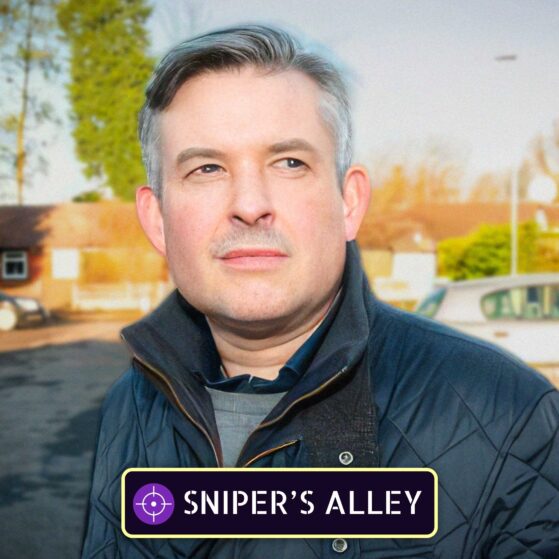
This is the transcript for episode 10 of Sniper’s Alley: The Gen X Podcast
Em, I want you to take yourself back, back in time to the time of COVID and lockdowns. What did you find yourself doing? Homeschooling, probably on my phone for between 12 and 15 hours a day, and drinking. The holy trinity of lockdown: homeschooling, doomscrolling, getting pissed.
Our guest today on Sniper’s Alley during that period was the Shadow Health Secretary. So probably was pretty busy himself. A bit more constructive than— Slightly more constructive, Em, no offence, but yeah, probably doing a bit more, yeah. So this is Jonathan Ashworth.
So we wanted to talk to Jonathan because, you know, as we’ve mentioned on the podcast before, Sniper’s Alley is this kind of informal term that we think came from medical circles. That, uh, Sniper’s Alley is the time of life between sort of late 40s through until mid-60s where people tend to get picked off by, you know, big life-changing events, whether that’s health, whether that’s big things like divorce, redundancy. And this podcast is all about what life is like for us all now whilst we are in Sniper’s Alley and we’re trying to navigate our way through it. And earlier this year, in January, when Jon was 47, he suffered a stroke.
And now he is helping people to learn more about this, because as you’ll find out when we speak to him, that he— you wouldn’t necessarily, you know, it wasn’t on his radar. And I think this is quite an important part about what we’re going to talk about. And he also talks a lot about recovery these days. So I’ve been following Jon on Instagram for a while.
He’s really, really engaging. He’s really open about what had happened to him, but it’s also really wonderful to see his recovery. And he shares his tips. And I think they’re not just tips for people who have had a stroke, obviously, and to look after it.
It’s about, it is, I know it’s really cheesy, but this is about how to live. So he talks a little bit about that in the interview. And we started off by asking him, to take us back to that night where it all happened and everything changed for him completely out of nowhere. And the context to this is I’m a 47-year-old who has run marathons, who has never smoked, who has never lived in fear of a question— the question that lots of politicians live in fear of, of as to have you ever taken anything illegal.
No, I’ve been very boring and straight-laced. Uh, I eat fruit and vegetables in my diet, um, so don’t lead a particularly excessive lifestyle. I do drink wine over dinner, but I don’t go to the pub every day. And in the early hours of New Year’s Day, I, I woke up with the most intense pins and needles and weird stiffness in my left arm.
I was completely confused. I thought I’d perhaps slept in an unusual way. This— it still didn’t go away. I Googled it.
It could be a trapped nerve, suggested Google. So I rang 111 expecting them to give me some advice on what to do if it was a trapped nerve. They took me through a series of questions and they said, sir, we think you’re having a stroke. We’re sending an ambulance for you.
And an ambulance turned up, you know, pretty quickly to be fair, and I was blue-lighted to the local hospital. And I had had a stroke, but the reason why it was all a surprise It’s because I didn’t have any facial drop. I hadn’t lost speech and language. I hadn’t lost sort of my eyesight, hadn’t gone blurry or anything.
It was just an intense sort of intensity in this pins and needles in my left arm, almost like it felt like my left arm was a prosthetic limb or something, like it wasn’t my arm, like a level of pins and needles I’ve never experienced. But even though I was shadow health secretary for 5 years and know a lot about health, it never would have occurred to me that I was having a stroke because I just assumed that a stroke involves, you know, speech slurring, facial drop, and all those things that those campaigns, those FAST face, um, speech campaigns tell you. But I’ve now learned that you can be FAST positive and FAST negative depending on the sort of stroke you’re having. So I was FAST negative, and I don’t think people particularly know that, that you can have a stroke and not have all those symptoms which most of us associate with stroke.
I think at first we thought it was quite a minor stroke, and actually when I went to have MRI scans and CT scans, it was a full-on stroke. It’s left me with ongoing stiffness in my left side. I can use my arm, but it’s left me with a stiffness, and it’s left me with— I’ve lost half my left field vision. So I’ve sort of lost half my vision in my left eye, which means I often bump into people at busy tube stations when I’m in London.
And looking back on the week before New Year’s Day, were there any, when you look back, were there any signs or symptoms that perhaps you ignored or? Probably yes. So I did ignore this. So at first they thought the cause of my stroke, which was essentially, let, let me put it in, in, in, in this way for Sniper’s Alley listeners, a stroke is a funny word.
It’s such a misleading word. It’s not really the right word for it. You stroke your partner’s hair, you might stroke your cat or your dog, you might stroke your newborn baby. I mean, it’s, it’s a very gentle word, you know, and yet we call this thing a stroke.
And it’s— some people have suggested it should be called a brain attack because a bit like when you with a heart attack, if you have an artery blocked going to your heart, it’s a similar thing with a stroke, except it’s an artery going to your brain, um, that gets blocked. That’s the ischemic stroke. So there’s a blood clot which blocks an artery in my brain, and for that moment, while that artery is blocked, that bit of your brain loses blood and oxygen, which is why the stroke can impact people in so many different ways depending on which bit of the brain is blocked. And for me, that means, you know, it could have been my speech and language, it could be my mobility, it could have been, you know, very personal things to do with personal hygiene.
It could have been all kinds of things. It happens, the bit of my brain where it’s hit me is links to my left eye and my left sort of shoulder and arm. It’s quite lucky really. So there was a blockage, that’s called an ischemic stroke.
I also had a bit of bleed on something in my brain called the thalamus. And your thalamus is a bit of your brain which regulates sensory input, which is why. The weird thing is my left arm feels like stiff. It feels like if you’ve overdone it in the gym or something.
The weirdness is it actually isn’t stiff, it’s just my brain is interpreting it as stiff. So it’s not like— so even though I do stretching and things like that, because it can’t— that’s not going to do any harm, it’s actually not a stiffness in the muscle as if I’ve lifted weights which are too heavy for me or something. It’s just the it’s this sort of disconnect between the sensory bit of my brain and that arm. It’s very peculiar, this.
Had I had any symptoms? Sorry, I went off on a tangent then. I do beg your pardon. So yes, I had, which I was ignoring.
I had noticed that after I’d been out for, say, like dinner and had, you know, wine with friends over dinner, that sort of thing, which is, you know, I drink lots of, probably too much wine over dinner, but I’m not the sort of person who goes to the pub every day. I always noticed that when I’d wake up early in the morning with heart palpitations, my heart beating quite rapidly Which I just dismissed and put down to the fact that, you know, late 40s, 50s, these things happen. I just ignored it. What we now think is that I’ve probably got some underlying heart thing, which when that heart— when my heart beats rapidly, it creates a blood clot.
And what happened is a blood clot was sent up, you know, just happened to have found its way into an artery in my brain, which is what caused the stroke. That’s what they think. I’m still having lots of tests with actually UCL Hospital in London, their stroke specialists there, to get to the bottom of it. But that’s now what their latest hypothesis is.
I think I know from— my dad’s in his 70s and has had a couple of strokes, and I know from kind of chatting to the medical staff that were looking after him, is that especially in those early stages after it’s just happened, and I think you touched on it there, Jon, it’s It’s quite a lottery, isn’t it? I mean, because, you know, the family is there obviously wanting to know, well, what happens now? You know, will they recover fully? And it can affect so— I imagine no two are the same.
Yeah, I mean, I mean, that’s right, because, because it is a— it’s basically a blockage in your brain, or the very worst case is when you’re— there was a huge hemorrhage bleed on your brain. Which is when that can lead to very serious, very, very serious repercussions. I’m not downplaying the ischemic stroke which happened to me, but, and essentially that is luck of the draw as to which bit of your brain where the blockage is and which bit of the brain, uh, is damaged and what, what bit of your body it controls. With me, as I said, it’s my left shoulder and arm and my left eyesight, which I’d obviously rather it hadn’t happened, obviously.
But it’s, you, you, you know, I can still live a, you know, I can’t drive, I don’t meet the minimum requirements for the DVLA, but other than that, it doesn’t really inhibit me in any way. But, you know, it could have been all, you know, could have been all kinds of different bits of me. I could have, you know, might have not been able to walk or speak or, or, or or whatever. But the, the frightening thing is somebody has a stroke every 5 minutes.
People expect that to increase to every 3 minutes. And increasing numbers are having stroke of working age, in their 40s and their 50s. It is not a disease, an affliction just of the elderly like we think of it. More and more people, men and women, are having, being hit by stroke in their 50s.
When they are in sniper’s alley, this period of your life when all of a sudden you start being hit by cardiovascular disease, lung disease, diabetes, stroke, or whatever. And you’re trying to walk through the alley, get from your early 50s to your 70s, or however long this, how many years this alley is, without being hit by one of these bullets. And that is the thing. I’m 47.
I came of age in the ’90s. It was an amazing time. We thought all the big problems in the world had been settled. We thought, in the lit words of one of the ’90s biggest bands, Oasis, that we were all gonna live forever.
We thought, you know, it was all now a world of excess, of fun, that we could do what we want. I always wanted to be a politician, so I actually had a great— My ’90s wasn’t as excessive as others, but it was a world in which lots of us thought you know, we were bulletproof and we would live forever in our 20s and teenage years in that period. Well, now we’re all getting into our late 40s, 50s, and so on. We’re now grappling with very different challenges.
Reality is catching up with us. Why is it increasing? Do— does anybody know? You mentioned that it’s— it is 1 in every 5 minutes, which sounds a ginormous number to me already.
I feel like it’s weirdly Having health anxiety about stroke has never been on my kind of radar. And I would, my ignorance shows that I would never have looked at you and thought, you know, well, he seems somebody. You know, I would not know the profile of somebody who was at risk of a stroke. And so hearing that it’s already 1 every 5 minutes and this is increasing to 1 every 3 minutes shows my, I’ve got no understanding of what the risks are, what the lifestyle risks are, and even why it’s increasing?
It is probably because of lifestyle. Stroke is usually preventable. It’s usually associated with all the bad things that we associate with illness— cholesterol, blood pressure. So it’s associated with obesity, smoking, drinking, all the things that we know are bad for us.
I’m a slightly separate case because I’ve never smoked. I did drink alcohol, as I said, but, you know, I ran marathons. I’m a slightly separate case. Mine’s probably some more genetic underlying heart thing, as it happens.
But they think that the, the projections on this are because of all those lifestyle things which are just making us iller as a society. You know, you know, it’s like all of these things. I mean, heart disease is projected to increase, cancers are projected to increase, and it’s usually to do with things like obesity. Like, smoking’s actually come down Smoking is not as acceptable as it used to be.
I always say this. I mean, when, I’m sure some of the listeners remember this, I first started work 20-odd years ago, I remember people, I’ve never smoked, but I remember people would smoke at their desk in the office. I mean, that would never happen now, would it? Can you imagine?
It would just be like, you’d be like, what? Well, it’s like smoking on planes. It just sounds ridiculous now, doesn’t it? Yeah, I do feel like when I talk to my kids about how we used to smoke, you’re telling them about a time when we didn’t have electricity or something.
Yeah. It seems like such bizarre kind of examples that you’re giving them. It’s really, yeah, so it’s all these kind of, so all of these, so having a stroke is obviously preventable, but I really wanted to touch on, like, you were shadow health minister. You’re really clued up.
You really understand all of these things, but you’ve talked in the past about not going for your wellness checks as well, sadly. Exactly. I know, and I want to talk about, ’cause I was talking to Rob about it and talking to my husband about it, And men are particularly bad. I think women aren’t perfect, but men are particularly bad.
And I wondered if there was— we could dig into that a little as to why you thought you didn’t go. I mean, absolutely. I’m such a hypocrite, aren’t I? I mean, I’ve, I’ve, I, I have made speeches and sort of supported campaigns for people to do this, and yet, you know, I’ve got all the text messages that, you know, the automated text messages from my local GP saying you’re due your health checkup, please, you know, you know, click here to book an appointment.
And I did the classic of, oh, I’ll sort it out tomorrow, I’m too busy, or I’m okay, there’s nothing wrong with me. And that is because, to a certain extent, up until this thing hit me, nothing ever was wrong with me, to be honest. So, you know, my blood pressure, whatever I’d check, was always fine. I was always, you know, you know, I’ve run marathons and half marathons, for goodness sake, you know.
Nobody— so I just assumed, oh, I’ll be okay. I ignored the fact that if I’d been out for dinner and drank too much wine, I was getting these heart palpitations. I think, you know, it’s just one of those things. So I classic example of somebody who does not follow his own advice, and I paid for it, paid the heavy price for it.
You know, it is a reminder that those checks, particularly when you’re in your late 40s and 50s, are really, really important because you are in this period when things start hitting you. I think one of the issues, I think, when you get to the, the sniper’s alley years that we find ourselves in now is that I would say on a pretty much weekly basis something doesn’t quite work exactly how it’s supposed to. Whether you get the niggles, you get the knee is not quite right, you’ve got— so, and you mentioned, you know, about your heart palpitations. And I, I think we, you know, if we did go to the GP with every single thing, we would not have time to do anything else.
So I think one of the hard things about navigating this is, is kind of knowing, having that knowledge as to, oh, this is serious, this needs to— we need to get this checked out. I think it’s quite hard to navigate sometimes. Yeah, I think that’s right, and it is hard. And, you know, I also know from my time as a shadow health secretary that a lot of GPs get frustrated that, um, so many people will turn up with just like common ailments.
Like, you know, like back in the day, you know, people have much more sort of common sense, and you would, you’d go off, you know, the, the lesson that, you know, Granny had always told you not to worry about things. But, and that— so there is a sort of, there’s a weird combination of the worried well who turn up at GP surgeries all the time, and then there’s those of us who are completely dismissive thinking, oh, that’s nothing to worry about. And it’s so difficult to get to get the balance right, isn’t it? Yeah, we were talking about this.
We were saying it has to be the Goldilocks. It has to be the exact right amount of anxiety. Like too little anxiety and you’re not following up things like heart palpitations. And exactly what you said as well, Jon, I think this is kind of what happened to me.
I went, I was completely fine and I was quite smug actually about my health. Like watching all the people on Instagram going, yeah, I’m doing my weights and, you know, doing everything that I should be doing. But when I got ill, I got really ill. And I think this is the thing about this age, is that there’s no kind of— before, when you were younger, there were kind of like these, oh, I’ve had a bit of a— I’ve had a warning shot and I need to start taking it easy and perhaps slow down a bit or eat a bit better.
There are no warning shots anymore. You absolutely, you know, you face it, you know, you run out of road very quickly. You feel a bit Wile E. Coyote running out of road as well.
You’re a bit like, oh gosh, I really, I really should have done something before. But I think we have to find a way to live that is the exact right amount of anxiety, that you’re not a frequent flyer to the GP, you’re not worrying about every single little ache and pain and catastrophizing every niggle, but you are taking your health seriously. And that’s got to begin with things like blood pressure. Yeah, I mean, I, you know, I really encourage anyone in their late 40s, 50s, go to the chemist, Buy yourself a blood pressure kit.
They’re £15, £20. Check your blood pressure pretty regularly. You’ve— you can look up online what, what the best blood pressure levels are supposed to be for your age. And if you’re worried about it, go to the GP and go, go on tablets.
I’ll be on blood pressure tablets and I’ll be on statins now for the rest of my life. It’s not onerous, you know, just take these tablets every morning. But if it’s going to keep me healthy, it’s going to— if it’s going to deal with my blood pressure and cholesterol and help me live longer, that’s a good thing. I do think as well that the blood pressure thing is a good thing because it’s trackable, you can follow it and you can see the kind of peaks and troughs.
And in fact, that’s one of the things, isn’t it? Is that you’ve gotta keep taking, you’re looking at patterns and trends, aren’t you? As much as, ’cause it will go up and down. And Michael, I bought one after I was getting headaches and went to the opticians And they took one look at the back of my eye and they could, they basically said, oh, high blood pressure, ’cause they can see.
And I suppose this is another thing is keeping it, you know, those dentist appointments and optician’s appointments can kind of fall by the wayside ’cause nobody’s got any time, we’re all time poor, but they can spot these things. And that’s what got, that’s how I ended up finding out I had high blood pressure. But I know from buying one of those blood pressure things that I have to keep, it’s gotta be out. My wife hates it because she wants to tidy it away.
But if it’s on the kitchen table, I’ll remember to do it. But if it’s out of sight, I’ll go months without it. So that’s my top tip is if you do have one, it’s gotta be, you’ve gotta see it and then you’ll do something about it. No, absolutely.
And it, you know, it could save your life, so it’s worth investing in one. So I’m really curious, do you think it’s a denial thing that somebody doesn’t, somebody who knows they’re overdrawn doesn’t wanna open their bank statement sort of mentality? Or do you think it’s genuinely a time issue that people aren’t, making the time just to go for these wellness checks and don’t think that there’s anything wrong with them? Well, I think the thing about— there’s always been a thing about men with their own health, not taking any of it seriously.
And we also have a bit of a culture, don’t we, among— in the UK, or certainly at all— don’t make a fuss, grin and bear it, get on with it. That’s very much part of our culture. And I’m always a sort of don’t make a fuss about it, you know. I know we don’t want to kind of stress too much about the kind of the Gen X generation, but I do think we were slightly raised with a, don’t take out of the system unless you need to take out of the system.
You know, the system only works if we don’t overstretch it. And I think we had this sort of mindset that you only troubled your GP with something that you were absolutely sure you needed to bother them with. And I do still feel that kind of anxiety of, do I really need to go? Should I really be going?
You know, we are a generation who knew people who had been in the war. Right. And those people in the war would’ve had an influence over our grandparents, or perhaps even our parents. In my case, my grandparents had been in the war, and therefore that whole kind of make do, waste not, want not, don’t make a fuss, get on with it, sort it out.
That sort of, that kind of wartime attitude would’ve been passed down to us as we were growing up in the ’70s and ’80s. I would— how are you now? ‘Cause I’ve, I’ve obviously, I’ve looked at your Instagram and you’re talking about depression and recovery and all the things that you’re doing to help your recovery. What— tell us a little bit about that.
So, so I’ve got— yeah, so on my Instagram account, I’ve sort of developed this sort of niche where on a Sunday afternoon I recite a poem that has been requested, usually while doing some Lego. The reason I do that is because when, when this first hit me, this hand was a bit like those claw games at the fairground where you have to try and pick up teddy bear, because that’s how it left me. So simple. The hand is pretty much fine now.
It feels a bit funny. But it moves. So the way to get it moving is to do lots of things with it. So what I did, one of the things I would do is I dug out my teenage daughter’s Lego sets.
They’re too old for Lego now. I started playing with them and doing Lego. And then I sort of started buying myself new Lego sets to do them. I sort of got myself addicted to these Lego sets where you make a bit of artwork.
So I’ve just finished a Monet water lilies painting made out of Lego. You know, they’re quite expensive, but there’s There could be worse expensive things I could be addicted to, I suppose. Um, so I was doing that, and then the other thing is I started reciting poetry. The reason I started reciting poetry is when I was lying in my hospital bed at this stage, I didn’t really know a lot about stroke.
I’ve obviously researched it all a lot since. I thought, my word, am I going to lose my speech and language? And, and although I’m not a full-time politician anymore, I earn my living by being able to speak, both by doing my media appearances and some of the um, freelance work I do. I have to present things, I have to speak at events.
You know, speaking is, is, you know, if I couldn’t speak, I’ve lost my livelihood. So I lay in the hospital bed rather pretentiously, actually, quoting from memory bits of Shakespeare and poems, because— not because I was trying to look like a show-off in hospital, but because I wanted to test myself on hard things to both sort of say and articulate, you know, complicated sort of sentences. Because I was thinking, oh my Lord, I’m gonna lose my speech. As it happens, as I’ve explained, it’s a different bit of my brain that was hit.
So that has slightly turned into me reciting poems, explaining this now, reciting poems on Instagram while doing Lego and putting out requests for, uh, people to suggest a poem they want me to recite. So, uh, I did some Seamus Heaney last week. The week before, I did a What did I do? I’ve done W.B.
Yeats, I’ve done Tennyson. Oh, you did W.B. Yeats’ Pilgrim Soul. I did, I love that one.
That’s very good for stuff, you know, when you’re— It’s so beautiful. It’s so beautiful. One man loved the pilgrim soul and knew it was blind. Oh yes, I did it.
When you’re old and grey and full of sleep and nodding by the fire, take down this book. It’s so beautiful. It’s love though, isn’t it? That’s what it all comes down to.
Slowly read and dream of the look your eyes had once. In the Shadow Sea book. How many loved your moments of glad grace? Emilie revealed in a recent episode of Sniper’s Alley that she has her teenage diary which is full of her poetry.
So I, I think one of these days, Jon, we’ll have to send you some. We’ll send you an Emilie original for you to read out. Yeah, I imagine it’s very— I imagine it’s good quality stuff. I think, I think, I think it’s probably on a par with WB Yates right there, but about boys.
Usually it was about, usually it was about, you know, yeah, an existential crisis that I’d had age 15. Yeah, the big ones. Yeah. When it comes to recovery with your particular experience of it, Jon, I would imagine it’s not a linear path.
Like, you know, if you break your ankle, it gets a little bit better every day, but I would imagine that’s maybe not the case with something related to, to the brain and something as complicated as this. No, it’s not linear. It peaks and troughs and That’s why a lot of stroke survivors do go on to develop depression, 1 in 3. And sadly, there are a number of stroke survivors who do end up in real crisis and doing some horrendous things.
Because first of all, that is to do with the fact that recovery is not linear, and you’re obviously fed up because you’re left with permanent disability of some form. Also, it’s to do with the fact that it’s, it is brain damage. It impacts your brain, so it, you, it could, it might give you a tendency, you know, to suffer depression or anxiety because of that bit of the brain has been damaged. It is not linear.
It’s not like, you know, waiting at home with a broken ankle and just putting it— it is, it peaks and troughs, but you’ve got to keep going. And the rehabilitation for stroke is tough. And part of the reason I do those Instagram videos and things is just to sort of give people confidence and hope that you can get through this and that life is worth living. There is a life to be lived after stroke, but it is hard because There are times— I’m quite lucky, I’ve not really suffered from immense fatigue that a lot of survivors have, um, where they just can’t focus on things, where they get brain fog and they have to sleep in the afternoons.
I’m, I’m lucky I’ve been able to work again and speak and articulate things. And, you know, I mean, I do get, I do get tired, but I think that’s just because people in the, you know, late 40s who’ve got 2 teenage daughters get tired. But I, I, I I’ve not, I’ve not really suffered from that, but for some stroke survivors, they can suffer from that, and it can be very debilitating, and they lose their livelihoods. They can’t go back to work and things like that.
I can. I, so I, I have been hugely lucky, but it’s, it’s always going to be there. It’s something that, that will now be part of your personality and your being, because it just is. It’s, it’s happened to you, and it’s changed you, because what happens with the brain— this is a slightly horrible bit— The brain cells die where, where that bit of the brain is hit.
Those brain cells die. So you are brain damaged. It sounds horrible because there’s lots of prejudice and so on about what that would mean, so people don’t really like to talk about it in those terms. The extraordinary thing about the brain though is that even though that bit of the brain, those brain cells have died, the brain, through something called neuroplasticity, finds new pathways Imagine it as a bit like you’re on Google Maps and the road you want to go down is blocked, so you get showed another route.
So the brain will find new routes. It’s why listeners of Sniper’s Alley in their 50s, if they wanted to try and learn, learn a new musical instrument or learn a second language, they could do it because the brain will find pathways to learn new things. But it has to be done consistently, intensely over time. So your rehabilitation, whether that’s physical rehabilitation or whatever, you need to put hours and hours into it, you know.
And you only get 6 hours worth from the NHS, or I did, because of the state. I think if you had a face service stroke, you’ll get more. Well, so that was an hour a week over 6 weeks. If I was to suggest to either of you or your listeners I might be making a presumption about you, I don’t know.
Apologies if I am. But if I was to suggest I want you to learn Russian by doing an hour a week on Duolingo for 6 weeks, I am guessing— I might be wrong here and I don’t want to offend you— but I’m guessing by the end of those 6 weeks, by only doing 1 hour a week on Duolingo, you will have not learned Russian. But you probably could learn Russian if you were prepared to put in hours and hours and hours of intensive work, because your brain would, would make those pathways for you to learn Russian. It’s the same with a stroke survivor.
If you’re prepared to put in the hours and hours and hours and hours of intensive work, your brain will find those new pathways. But not if it’s just 1 hour a week, which is the, which is the sort of minimum, which is what you, which you, what you get from the NHS. I heard you were learning piano, Jon. Is that, is that correct?
Yeah, yeah. So I mean, my New Year’s resolution was to learn piano anyway, so I’ve been doing piano, um, which is, which is what I wanted to do. So there’s some videos on my Instagram of me playing the piano badly. You know, that is, that’s really helped.
Another thing that helped me get this hand moving and And I think, I mean, there’s lots of experts out there who will say that sort of musical therapy and the coordination between your hands and your brain and your eyes, that’s— there’s people out there, stroke experts, will say that’s really good work for stroke recovery as well. So yeah, I’ve been doing that as well. And you mentioned your left eye and sometimes bumping into people when you’re on the tube, because I guess your peripheral vision is is gone. Is— what’s the prognosis for that?
Is that permanent, or is there no way of predicting these things? Um, they think it’s probably gone forever. If it hadn’t come back within 6 months, they think it’s probably gone. However, I have spoken to people who’ve said there are examples of it coming back.
You know, one stroke survivor was telling me that they were deaf. They went deaf. They were deaf for about 18 months, and then suddenly one day, bang, hearing just came back. So I don’t give up hope, um, but at the moment I’m just assuming that I’ll carry on walking into grumpy people at tube stations.
But people are grumpy. I would have been grumpy because people are so unforgiving in London and impatient. Yeah, it’s much worse people to have bump into you than you. But, um, so your New Year’s resolution— so you’re coming up to— I don’t know whether these kind of things play on your mind, maybe they do, but you’re coming up to your kind year’s anniversary.
I mean, what a day to kind of have it, you know. There’s no, there’s no forgetting that day. So you’re coming up to your year’s anniversary. How do you feel about that?
How do you feel about— in some ways I’m quite matter-of-fact about it because it is what it is, but the whole thing has taught me there is a life to be lived. I know these things can— I know these sorts of podcasts and sort of Instagram accounts are full of this very, you know, these sorts of almost clichéd— I know, I don’t want to sound rude by saying cliché, but I know, but you know, there’s lots of this out there. But it’s true though, we are too often fearing what might happen in the future. And actually, I think the whole thing has taught me you’ve got to live in the present and enjoy the present as much as possible.
We can get, we can get ourselves so wound up and worked up about worrying about something that might go wrong in the future. I’ve done a lot of that in my time in politics, worrying about things which might not go to plan in the future. And actually, I’ve decided that why, why waste so much energy worrying about things that might not ever happen? Enjoy the here and now.
And I think it— I mean, there’s a lot, there’s a lot that’s tricky about this age, but if that’s one thing that we can have, this sort of sense of, look, we know that this is bollocks and we shouldn’t be worried about it— if that’s the one thing that we can get, that’s pretty good. I think that’s a big thing. It reminds me of what one episode we spoke to James, who again round about our age, Sniper’s Alley, um, and he had prostate cancer and, and made a, a full recovery. But he took from it something very similar to what you’re saying, Jon.
And in fact, he’s, he’s already kind of— he’s brought his retirement forward because he doesn’t want to be working, you know, for the— there’s other things that he wants to do and We’ve mentioned this quite a few times on the, the podcast, that it is a— it’s a time of life where time doesn’t feel quite as infinite as it used to. And I think you find yourself being much more careful about what you use that time for. And, you know, I don’t think that’s a— it’s not a bad message, is it really? No, I think that’s absolutely the right way to look at it.
And as I said, in the ’90s when we were all coming of age and listening to Oasis perhaps We all thought we were going to live forever, in the words of Oasis. And if I look back on the last 25 years, I’ve gone through the round of university, then going to my friends’, best friends’ weddings, then comforting them as they go through their divorces, sharing their excitement as they find their new partners, sharing the excitement if they perhaps even are now moving into having grandchildren, thinking, crikey, how did that happen? And now we’re in this age where we’re all talking to one another about Um, illnesses. And sadly, also in this age where some of the people I’ve known since university have started leaving us, have, you know, died from cancers and things.
So, and I’ve seen that whole cycle now. I think the whole thing that has taught me is that we do not live forever, and we’ve got to make the most of every moment we have, because you’re a long time dead, and you also sleep when you’re dead. So Enjoy the adventures. Enjoy adventures now.
Huge thank you to Jonathan Ashworth for both his time and just being so kind of open to sharing his experience. And I think what he’s doing, especially what he’s doing on Instagram, what a great use for his platform, talking about the recovery and how he’s going about it. It’s great, isn’t it? It’s actually really moving.
I really love the poems that he reads. They’re really lovely. And I really love seeing his recovery and seeing him so well. And go and get your blood pressure checked.
That’s the thing to take from this, isn’t it? That is the thing to take. And I think the thing to take from this, 2 things I think to take from this. Number one, there were really no symptoms or symptoms that could be easily explained away, you know, something else.
So the kind of symptoms that were easily ignored if there was a symptom. And number 2, that you need to go and get your blood pressure checked. So if you’ve been invited, If you’re listening to this and you’re sitting on a wellness check or you haven’t, you have ignored a request from your GP, just go and get your blood pressure checked, just get it ticked off. We should do a thing on our Instagram where people post their blood pressure results.
If that’s gonna get people, come on, come and tell us. We should point out, by the way, that obviously it’s not whoever gets the biggest number wins, okay? There’s no prize for having massive hypertension. This is it, go.
But generally, if you’ve had a period of stress, it’s a really stressful time, it’s a really stressful age, go and get your blood pressure checked. If you’d like to get in touch, if anything that Jonathan said has resonated— I’m sure it will— you can get a hold of us probably on Instagram is probably the best way, which is @snipersalleypodcast. Uh, Jon’s Instagram page is, uh, Jon Ashworth, @jonashworth, J-O-N. And you can also get a hold of us via our website,